In our previous blog, we explained what stretch film welding is and how it works on a Automatic pallet wrapper. The next question most businesses ask is whether they actually need it. The answer comes down to how automated you want your operation to be, the expectations of your customers, and how important presentation and consistency are in your dispatch process.
What is Film Welding?
Film welding is used to secure the tail of the stretch wrap at the end of the wrapping cycle. Instead of leaving a loose piece of film hanging off the pallet, the machine cuts and heat-welds the film neatly to the load. This removes the need for an operator to wipe down or tape the film and ensures every pallet leaves the machine with a clean, consistent finish.
Without film welding, you are almost always left with a film tail. While this might seem minor, it introduces an extra step into the process and creates inconsistency between pallets depending on how that tail is handled. Heres a video of the Mytho Auto welding film
Why Would You Need Film Welding?
A Truly Hands-Off Operation
If you are investing in an automatic pallet wrapper, the goal is usually to minimise operator involvement. You load the pallet, start the cycle, and move on to the next task. Film welding insures that the film tail stays attached to the pallet and doesnt create a loose tail of film.
A More Professional Finish
Presentation plays a bigger role than many expect. A pallet with a loose tail of stretch film can look unfinished or poorly wrapped, even if the load itself is secure. Film welding provides a neat, sealed finish every time, giving your pallets a more professional and consistent appearance as they leave your warehouse.
Meeting Retail Standards
For businesses supplying major retailers such as Coles and Woolworths distribution centers, wrapping quality is critical. Pallets with loose film tails, often referred to as “dag tails,” are commonly rejected at receiving docks. These tails can catch during handling or transport and are seen as a sign of poor wrapping practices. Film welding eliminates this issue entirely by securing the film cleanly to the load, helping ensure your pallets meet strict compliance standards.
Improved Consistency and Load Security
While film welding is primarily about presentation and automation, it also improves consistency in your wrapping process. A loose film tail can become a weak point where the wrap may start to unravel during transit. By welding the film in place, you remove that variable and ensure each pallet is finished the same way every time.
Reduced Labour and Faster Throughput
Even a small task like taping down a film tail becomes significant when repeated across dozens or hundreds of pallets per day. It slows down operators and adds unnecessary handling to the process. Film welding removes this step entirely, allowing your team to maintain workflow efficiency and focus on more productive tasks.
When You Might Not Need Film Welding
Film welding is not essential for every operation. If you are using a semi-automatic pallet wrapper, where an operator is already involved in attaching and cutting the film, manually securing the tail may not be an issue. It may also be less important in internal warehouse environments where pallets are not being presented to customers or retailers, and appearance is not a priority.
In these cases, a standard cut-and-hold system or manual wipe-down process can still be perfectly suitable.
What is the downside of film welding on an automatic pallet wrapper?
Film welding does come with a trade-off, and that is increased maintenance. Because you are adding heat elements, cutting systems, and additional control components, the machine becomes significantly more complex compared to a standard automatic wrapper. For smaller operators or lower-throughput sites, this added complexity may not always justify the investment, particularly when factoring in ongoing servicing and potential downtime. It is also important to consider the design of the system itself. 
Some machines place the film welding unit directly on the turntable, which introduces a high level of mechanical and electrical complexity in an area that is constantly exposed to impact and operator interaction. These setups often rely on delicate components that can be easily damaged, and in many cases use consumables like teflon tape rather than proper teflon-coated steel welding elements. As a result, they can become costly to maintain over time, with more frequent part replacements and higher service requirements compared to simpler, mast-mounted systems. High autyomatic film welding system like the Atlanta stretch mytho auto don't have the film welding on the turntable, greatly reducing maintenance costs, and critical downtime.
Final film Thoughts
Film welding is not just about cutting and sealing stretch film. It is about removing the final piece of manual interaction from the wrapping process while improving the overall presentation and consistency of your pallets.
If your goal is to create a more efficient operation, reduce handling, and ensure your pallets meet higher standards when they leave your facility, then film welding is a feature well worth considering, but if these are not important to you then you can certainly live without it as most people do.
Continued Stretch film welding info:
What is a film tail tag?
A film tail “dag” refers to the loose piece of stretch film left hanging off a pallet after wrapping. Instead of the film being secured neatly to the load, the end of the wrap is left sticking out, often flapping or trailing down the side of the pallet.
This typically happens on machines without film welding or when the operator doesn’t wipe down or tape the film properly at the end of the cycle. While it might seem minor, a film dag can cause several issues. It can catch during transport or when pallets are moved, which may start unravelling the wrap and compromise load stability. It also creates a messy, unprofessional appearance, especially for goods being shipped to customers or retail distribution centres.
In stricter supply chains, particularly with large retailers like Coles and Woolworths, film dags are often flagged as non-compliant. A pallet may be rejected simply because of a loose film tail, as it indicates poor wrapping quality and presents a risk during handling. This is why features like film welding are commonly used—to eliminate the film tail entirely and ensure a clean, secure finish every time.
What machines does MPS offer with film welding?
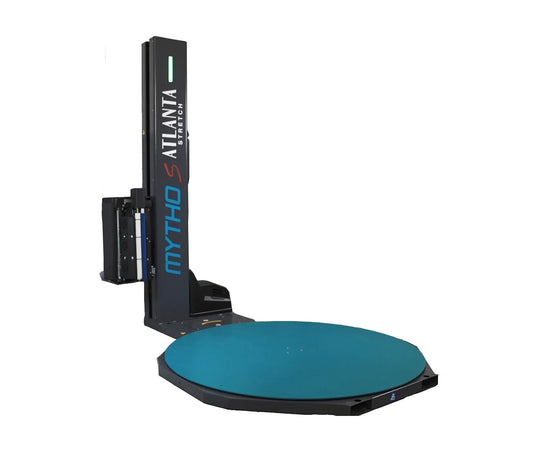
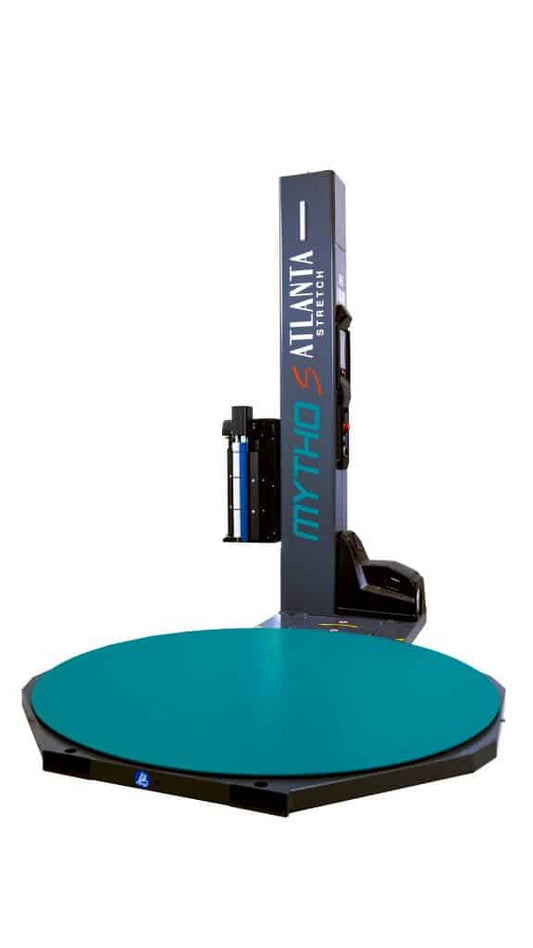
At MPS Packaging Australia, film welding is typically found on our true automatic pallet wrapping machines, with the standout example being the Atlanta Stretch Mytho Auto pallet wrapper. This is our premium automatic platform, designed so the operator can load a pallet, press start, and walk away, with the machine automatically cutting and securing the film at the end of the cycle. The Mytho Auto can be configured with a clamp, cut and film welding system, allowing the film tail to be welded directly to the pallet for a clean, compliant finish . In higher-end fully auto machines such as the Mytho A and inline Mytho systems, this welding system . While not all automatic systems require welding, it is generally featured on MPS’s top-tier automatic wrappers where full hands-off operation, retail compliance, and presentation are critical.
What Are the Alternatives to Film Welding on an Automatic Pallet Wrapper?
When looking at automatic pallet wrappers, film welding is often seen as the premium solution for securing the end of the stretch film. It provides a clean, sealed finish and allows for a completely hands-off operation. However, it’s not the only option available, and in many cases, it may not be the most suitable solution depending on your operation, budget, and throughput.
So what are the alternatives to film welding, and how do they compare?
Clamp, Cut & Hold Systems
One of the most common alternatives to film welding is a clamp, cut and hold system. In this setup, the machine clamps the film, cuts it at the end of the cycle, and then holds the film ready for the next pallet.
While this works well from a machine perspective, it does not secure the film to the pallet itself. This means the wrapped load will still have a film tail unless the film naturally sticks to the load or an operator intervenes.
For many lower-volume operations, this is perfectly acceptable. However, it does mean the process is not truly hands-off, and consistency will depend on the load shape and film performance.
Clamp, Cut & Wipe Systems
A step up from basic clamp and cut systems is the clamp, cut and wipe function. In this configuration, the machine uses a mechanical arm or pad to wipe the film tail against the pallet after cutting.
This relies on the natural cling of the stretch film to hold the tail in place. When set up correctly, it can produce a reasonably clean finish without requiring heat or welding components.
However, the effectiveness of this system depends heavily on factors such as film quality, load shape, and wrap tension. Inconsistent loads or lower-grade films can result in tails lifting or coming loose during transport.
Manual Intervention (Taping or Wiping)
Another common alternative, particularly when upgrading from semi-automatic machines, is to rely on manual intervention. After the wrap cycle is complete, an operator tapes or wipes down the film tail by hand.
While this method is low cost and simple, it introduces additional labour into the process and removes the benefit of automation. It also leads to inconsistency, as different operators may secure the film differently.
In higher-volume operations, this small step quickly becomes a bottleneck. However most Semi auto machines can easily be equipped with an auto cutting system, which is a significant cost saving vs and automatic machine.
Do all film welding systems use a roper device?
No — not all film welding systems use a roping device, A roping device is only required on certain types of film welding systems, typically those that use a small welding pad located at the bottom of the pallet. In these setups, the machine gathers (or “ropes”) the film into a narrow band before welding it. This allows the small welding pad to effectively seal the film, as it’s dealing with a concentrated strip rather than a full sheet of film.
However, most modern and higher-end film welding systems do not use a roping device at all. Instead, they utilise full-width welding bars or larger welding elements, which can seal the film across its natural width without needing to bunch it together.
Roping devices themselves add another moving part to the machine, which means more components to adjust, maintain, and potentially fail over time. They can also slightly reduce the surface area of the film at the end of the wrap, which in some cases may impact how the film holds to the load.
Does the type of stretch film matter on film welding?
Yes — the type of stretch wrap does matter when it comes to film welding, but probably not in the way most people think.
The majority of stretch films used on pallet wrappers are made from LLDPE (Linear Low Density Polyethylene), often with metallocene blends. Because of this, almost all standard pallet wraps on the market will weld successfully. From a material standpoint, you’re not dealing with completely different plastics — you’re dealing with variations of the same base material, which is designed to stretch, cling, and in this case, weld.
Where things start to change is not the material itself, but the thickness and formulation of the film. Thicker films, or films with higher performance blends, will require more energy to achieve a proper weld. Thinner films, on the other hand, can weld very quickly and may even burn through if too much heat or time is applied.
This is why film welding systems are adjustable. On most machines, the welding parameters can be tuned through settings such as weld time, pressure, and in some cases the length of contact or dwell time of the welding pad. Getting this balance right is critical. Too little time or pressure and the film won’t bond properly, leading to weak seals or tails lifting. Too much heat or dwell time and you risk damaging the film, creating holes or brittle weld points.
It’s also worth noting that different films — even if they are all LLDPE — can behave slightly differently depending on their additives, recycled content, or stretch characteristics. Higher-end films with consistent blends will generally produce more reliable welds, while lower-grade or heavily recycled films may require more precise tuning.
In short, almost all pallet stretch wraps will weld, but achieving a strong, clean weld comes down to correctly setting the machine based on the film thickness and quality rather than the material type itself.