Robotic pallet wrappers are one of the most misunderstood pieces of packaging equipment in the industry. A robotic pallet wrapper is not designed to replace every type of machine, but in the right application, it can deliver outstanding flexibility, improved safety, and strong cost efficiency compared to traditional systems.
What is a Robotic Pallet Wrapper?
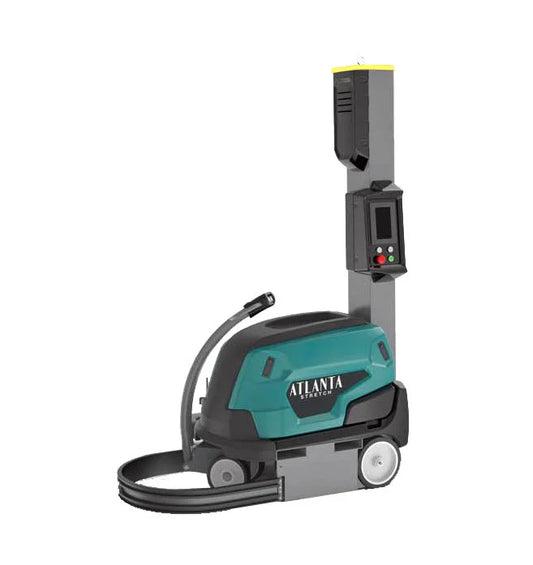
A robotic pallet wrapper is a mobile stretch wrapping machine that travels around the pallet, rather than requiring the pallet to rotate on a turntable. This means the load remains completely stationary while the machine moves around it. As a result, wrapping can be carried out anywhere in your warehouse without needing a fixed installation. Unlike conventional machines, robotic wrappers such as the Atlanta Stretch Sfera and Neos are built for real-world conditions where loads are not always uniform or consistent.
Here's a video we made of our Neos pallet wrapper wrapping a pallet wrapping machine crate, the size of this crate is 2300mm x 1800mm x 600mm high, which is completely impossible to wrap on a turntable wrapper.
How Do Robotic Wrappers Work?
The operation of a robotic wrapper is straightforward, but modern machines have evolved significantly in capability. The operator simply positions the robot next to the pallet and attaches the film, unless the machine is equipped with an automatic system. Once started, the robot drives around the pallet using a guide wheel, At the end of the cycle, the machine stops automatically. Premium models such as the Sfera and Neos include automatic height detection, advanced safety systems, programmable wrapping cycles, and high-capacity battery systems, making them both efficient and easy to operate.
Why Choose a Robotic Pallet Wrapper?
One of the biggest advantages of a robotic pallet wrapper is that there are effectively no weight limitations. Because there is no turntable platform, you are not restricted by bearings, gearboxes, or structural limits. The pallet remains on the warehouse floor, making these machines ideal for heavy products, dense loads, and oversized goods that would otherwise exceed the capacity of a traditional wrapper.
Another major benefit is the ability to wrap irregular or difficult loads. Many operations deal with pallets that are overhanging, unstable, mixed in size, or unusually shaped. In these situations, a turntable machine can struggle or even create safety risks. Robotic wrappers, particularly machines like the Neos, excel in these applications and are commonly used for wrapping furniture, whitegoods, long panels, and pallets that simply cannot be handled by conventional equipment.
Flexibility is also a key advantage. A robotic wrapper does not require a fixed position, meaning it can be moved between different areas of a warehouse as needed. This is particularly valuable in operations where wrapping occurs at multiple points or where space is limited. Instead of bringing every pallet to a machine, the machine goes to the pallet, reducing handling and improving workflow efficiency.
Sfera vs Neos — Which Robot is Right for You?
At MPS Packaging Australia, we supply robotic pallet wrappers based on the Atlanta Stretch platform, known for its durability and use of commercial-grade components. The Sfera robot wrapper is typically suited to entry-level or mid-range applications where flexibility is required but volumes are moderate. It offers a simple, reliable design that is easy to operate and is ideal for businesses looking to introduce robotic wrapping without over complicating the process.
The Neos robot wrapper, on the other hand, is designed for higher volume operations and more demanding environments. It features a powered pre-stretch carriage for significant film savings, along with advanced electronics and enhanced control systems. The Neos is often selected where performance, efficiency, and long-term cost reduction are key priorities. It is also well suited to applications involving large or нестandard loads where other machine types may not be viable.
Watch our demo video where we wrap 3 pallets and move them while they're been wrapped, this process is faster than a turntable machine, because you can start wrapping the next pallet BEFORE you move the old one. while the next one wraps, you move the old one. Robotic pallet wrappers are for this reason faster than an automatic machine.
Safety is another important factor. With a turntable wrapper, the load is rotated at speed, which can cause unstable pallets to shift or collapse. A robotic wrapper eliminates this risk by keeping the load stationary, allowing tension to be applied more gradually and consistently. This makes it a strong choice for tall, lightweight, or poorly stacked pallets.
Finally, higher-end robotic wrappers such as the Atlanta Neos videoed above incorporate powered pre-stretch systems. This allows the machine to stretch the film before it is applied, turning one metre of film into two or even three metres. The result is a significant reduction in film consumption, which directly lowers ongoing packaging costs compared to basic friction brake systems.
Robot vs Turntable — What’s the Real Difference?
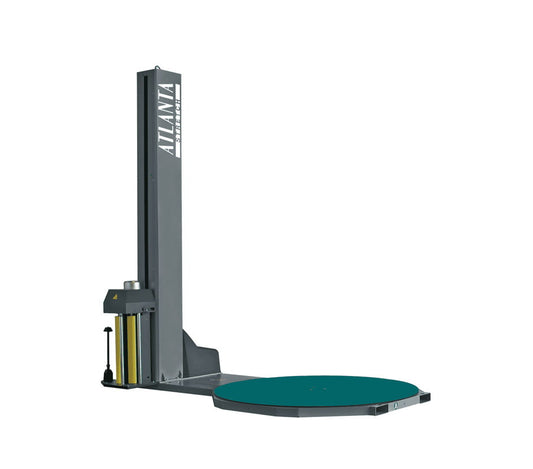
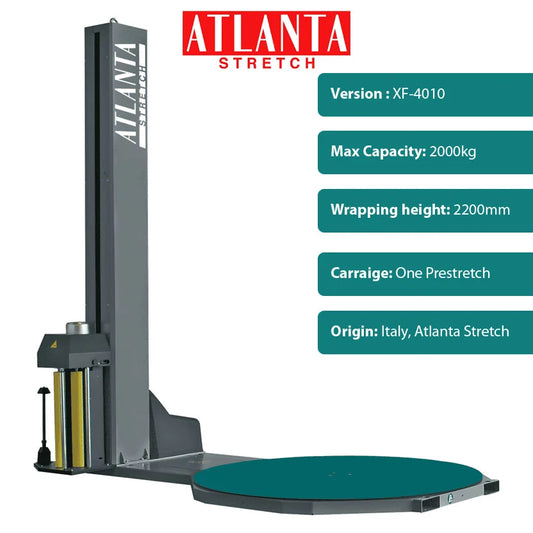
The core difference between a robotic wrapper and a turntable wrapper lies in how the pallet is handled. A robotic wrapper is mobile and keeps the pallet stationary, while a turntable wrapper is fixed in position and rotates the load during wrapping. This fundamental difference impacts weight capacity, flexibility, and application suitability. Robotic wrappers offer far greater adaptability and are ideal for irregular or oversized loads, whereas turntable machines are typically better suited to consistent, repeatable pallet types in fixed locations.
When a Robotic Wrapper Makes Sense
A robotic pallet wrapper is generally the right choice when pallets are wrapped in multiple locations, when load sizes and shapes vary, or when pallets exceed the limits of a turntable machine. It is also well suited to operations that want to reduce manual handling or improve safety when dealing with unstable loads. In these situations, the flexibility and mobility of a robotic system can provide a clear advantage.
In this video demonstration, we show the Atlanta Stretch Neos pallet wrapping robot in action, wrapping extremely long 14-metre panels quickly and efficiently. Applications like this highlight exactly where robotic pallet wrappers excel—when goods are simply too large or impractical to wrap on traditional machines.
Turntable pallet wrappers are designed for standard pallet sizes. When products become exceptionally long, such as structural panels, aluminium sections, timber beams, or long fabricated components, rotating the load on a turntable becomes impossible. Robots also excel at items like spa's or swim spas.
Final Robot wrapper Thoughts
Robotic pallet wrappers such as the Sfera and Neos fill a specific and important role in modern warehousing. They are not intended to replace every type of wrapping machine, but in the right application, they can offer unmatched flexibility and performance. At MPS Packaging Australia, our approach is to match the right machine to your operation, ensuring you achieve the best possible outcome in both efficiency and cost.