Robotic pallet wrappers have traditionally been seen as a semi-automatic solution. You bring the robot to the pallet, attach the film, press start, and the machine wraps the load.
But that is changing — fast.
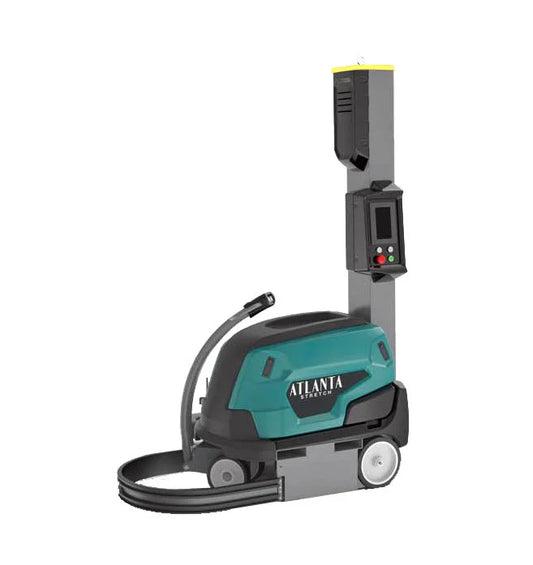
With the introduction of machines like the Atlanta Stretch MIRA, robotic pallet wrapping is moving beyond semi-automatic operation and into a new category entirely: fully autonomous wrapping systems.
So the real question is no longer “are robots semi-automatic?” — it’s now:
Can a robotic pallet wrapper be fully automatic?
The answer is yes — and MIRA is leading that shift.
Enter MIRA — The Fully Autonomous Robot Wrapper
The Atlanta Stretch MIRA changes that completely.
Unlike traditional robotic wrappers, MIRA is designed to operate with full independence, removing the need for constant operator involvement.
It is not just a robot that wraps pallets — it is a robot that thinks, moves, and works on its own.
MIRA can navigate its environment, move between pallets, and complete wrapping cycles without manual input, making it one of the first systems to truly blur the line between robotic and fully automatic pallet wrapping.

What Makes MIRA Fully Automatic?
The key difference between MIRA and standard robotic wrappers is its ability to operate as part of a continuous, automated process.
MIRA uses a sophisticated navigation system that allows it to move independently around the warehouse, travelling from one pallet to another without needing to be repositioned.
Once it reaches a pallet, it performs the entire wrapping cycle automatically using the ARYA system, completing every stage without operator input.
This means the machine is no longer dependent on an operator standing beside it — it becomes part of your workflow.
Multi-Station Wrapping — The Real Game Changer
One of the most important features of the MIRA is its multi-station capability.
Traditional robotic wrappers handle one pallet at a time and require repositioning after each cycle. MIRA, however, can move between multiple wrapping stations, completing jobs continuously without interruption.
This effectively creates a mobile automatic system, without the need for conveyors or fixed infrastructure.
Instead of pallets coming to the machine, and instead of the operator moving the robot, MIRA creates a third model:
The robot moves itself between pallets and keeps working.
This is what elevates it from automatic to fully autonomous.
No Contact Wrapping — A Different Approach
Another major difference with MIRA is its ability to wrap loads without direct contact.
This is particularly important for нестандарт applications where:
- Loads are unstable
- Products overhang the pallet
- There is no standard pallet base
By removing contact with the load, MIRA can wrap difficult or goods that would be challenging for both turntable and traditional robotic systems.
Safety Systems That Enable Autonomy
For a robot to operate independently in a warehouse, safety becomes critical.
MIRA incorporates advanced safety systems that allow it to work around people and obstacles without creating risk.
These include obstacle detection systems that allow the robot to recognise and avoid objects in its path, as well as visual indicators such as a blue light arc that defines its operating zone. If a person enters this zone, the machine can stop automatically.
It also communicates its movements and status in real time using visual signals, ensuring nearby operators always understand what the machine is doing.
How Automatic is “Fully Automatic”?
It’s important to be clear — “fully automatic” can mean different things depending on the system.
A conveyorised pallet wrapper is fully automatic because it removes labour entirely, but it is fixed in one location.
MIRA achieves automation differently.
It removes the need for:
- Manual positioning
- Constant operator supervision
- Repetitive handling
But instead of being fixed, it introduces mobility and flexibility.
So rather than replacing conveyor systems, it creates a new category of automation: Autonomous mobile wrapping
The Future of Robotic Pallet Wrapping
MIRA represents a shift in how pallet wrapping machines are designed and used.
For years, the industry has been split between:
- Flexible but manual systems
- Fully automatic but fixed systems
Autonomous robots bring these two worlds together.
They allow warehouses to automate without locking themselves into a rigid layout, which is becoming increasingly important as operations evolve and change.
The ayra auto attach system.
The ARYA automatic attach system on a robotic pallet wrapper is designed to remove one of the last manual steps in the wrapping process — attaching the film to the pallet at the start of the cycle. On traditional robotic wrappers, the operator still needs to walk up to the load, pull the film off the carriage, and secure it to the pallet before pressing start. ARYA eliminates this step entirely, allowing the machine to begin wrapping without operator involvement.
The system works by using a controlled film delivery and attachment mechanism built into the carriage. When the wrap cycle is initiated, ARYA feeds the film out in a precise manner and uses a combination of tension, positioning, and controlled contact with the load to “grab” and secure the film onto the pallet. Instead of relying on manual tying or tucking, the machine ensures the film adheres correctly so the wrap cycle can begin cleanly and consistently every time.
What makes ARYA particularly important in robotic applications is that it enables true automation. Without an automatic attach system, even the most advanced robot still relies on an operator to start each cycle. With ARYA, machines like the MIRA can move to a pallet, attach the film themselves, complete the wrap, and move on to the next load without human intervention. This is what allows robotic wrappers to transition from semi-automatic machines into fully autonomous systems.
From a practical standpoint, the benefits go beyond labour reduction. Automatic attachment improves consistency, reduces film waste from poor starts, and eliminates one of the most common causes of wrapping issues — incorrect film tying. It also improves safety by reducing the need for operators to interact closely with the machine during operation, particularly in high-throughput or automated environments.
When is a robot better than a turntable wrapper?
Robotic pallet wrappers can be superior to turntable machines in applications where flexibility, load variation, and weight are key factors. Unlike a turntable wrapper, the pallet remains stationary, which eliminates weight limits and reduces the risk of loads shifting or collapsing during rotation. This makes robots ideal for heavy or unstable pallets that would otherwise be difficult or unsafe to wrap on a spinning platform.
In addition, robotic wrappers can move throughout the warehouse and wrap pallets wherever they are located, removing the need to bring every load to a fixed machine. This not only improves workflow efficiency but also reduces handling time and reliance on forklifts. When combined with modern features such as pre-stretch film systems and advanced sensors, robotic wrappers offer a highly adaptable solution that can outperform traditional turntable machines in the right environment.
Final Thoughts
So, can robotic pallet wrappers be automatic?
Yes — but more importantly, they can now be fully autonomous.
Machines like the Atlanta Stretch MIRA are redefining what is possible in pallet wrapping, combining mobility, intelligence, and automation into a single system.
At MPS Packaging Australia, we see robotic wrappers as part of a broader solution — not a one-size-fits-all answer.
Whether it’s a Sfera, a Neos, or a fully autonomous system like MIRA, the key is always the same: Matching the right level of automation to your operation.