Robot pallet wrappers have quickly become one of the most talked-about solutions in modern warehousing and logistics. Their ability to wrap pallets of virtually any size, without the need for a fixed installation, makes them an incredibly flexible option for many businesses.
What Is a Robot Pallet Wrapper?
A robot pallet wrapper, often referred to as a mobile stretch wrapper, is a self-driven machine that travels around a stationary pallet while applying stretch film. Unlike a traditional turntable wrapper, the pallet remains still while the robot moves around it.
This allows operators to wrap oversized, heavy, or awkward loads that wouldn’t normally suit a standard pallet wrapper. It also removes the need for ramps, pits, or fixed wrapping zones, as the machine can simply be driven to wherever the pallet is located. For many operations, this flexibility is the biggest advantage of going down the robotic path.

How Much Do Robot Pallet Wrappers Cost in Australia?
When it comes to pricing, this is where the market can become misleading. In Australia, robot pallet wrappers are often positioned as premium or highly specialised equipment, and this can lead to heavily inflated pricing.
The reality is much simpler. A high-quality robot pallet wrapper should generally sit well under AUD $20,000. If you are paying anywhere close to that figure, or above it, there is a strong chance you are overpaying.
At MPS Packaging Australia, even our top-tier robotic machines fall within this range, and none of our customers have ever paid over $20,000 for a robot wrapper. This includes machines that are considered among the best available globally.
Why Robot Wrappers Are Often Overpriced
Despite how they are marketed, robot pallet wrappers are not overly complex machines. They run on sealed AGM batteries, meaning there is no need for complex electrical infrastructure or installation.
From a mechanical standpoint, they are relatively straightforward. They use standard drive motors and control systems to navigate around the pallet, and compared to turntable machines, they often have fewer critical wear components. There are no large rotating platforms, no heavy-duty gear systems under load, and fewer mechanical stress points overall.
Because of this, manufacturing and servicing costs are lower than many people expect. There are fewer components to fail and fewer specialised parts required. This is why pricing in the market can sometimes be disconnected from the actual cost and complexity of the machine.
The NEOS Robot Pallet Wrapper

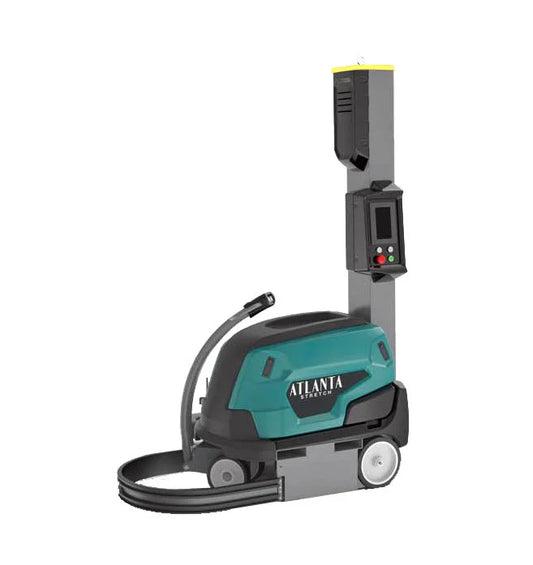
The NEOS robot pallet wrapper from Atlanta Stretch is one of the most proven robotic systems available today. It is widely regarded as a top-end machine, built with high-quality Italian engineering and reliable industrial components.
The NEOS is designed to handle a wide range of applications, from standard pallets through to oversized and irregular loads. It features a powered pre-stretch carriage, allowing operators to significantly reduce film usage while maintaining strong load containment. The machine is compact, easy to manoeuvre, and built for long-term reliability in demanding warehouse environments.
Importantly, even as a premium robot, the NEOS still sits within realistic pricing expectations and does not justify the inflated figures often seen in the market.
The SFERA Robot Wrapper

The SFERA robot pallet wrapper provides a strong alternative for businesses looking for a flexible and cost-effective robotic solution. It is designed with simplicity and usability in mind, making it ideal for operations that want the benefits of a robot without unnecessary complexity.
SFERA delivers consistent performance across a wide range of pallet sizes and applications. It offers a practical entry point into robotic wrapping while still maintaining the reliability and functionality expected from a professional-grade machine.
Where Businesses Get Caught Out
One of the biggest issues we see is businesses being quoted well above market value for robot pallet wrappers. It is not uncommon to see pricing in the range of $22,000 to $30,000 or more, often justified by claims of advanced technology or premium features.
In reality, robot pallet wrappers are not fully automatic systems, nor are they mechanically complex enough to warrant those price points. In many cases, the additional cost is not tied to performance or reliability, but rather to branding, markups, or unnecessary add-ons.
Understanding what the machine actually is, and how it operates, is key to avoiding overpaying.
Is a Robot Wrapper Right for Your Application?
Robot pallet wrappers are best suited to operations where flexibility is critical. This includes situations where pallet sizes vary, where loads are oversized or difficult to handle, or where wrapping needs to occur in multiple locations.
For operations with consistent, standard-sized pallets in a fixed wrapping area, a turntable wrapper may still be a more cost-effective solution. Choosing the right machine ultimately comes down to how your operation runs day to day.
The Advantages of Robot Pallet Wrappers
Why More Australian Businesses Are Moving to Mobile Wrapping
Robot pallet wrappers have gone from a niche solution to a mainstream choice across warehouses, manufacturing plants, and distribution centres. While traditional turntable machines still have their place, robotic pallet wrappers offer a level of flexibility and practicality that is hard to match.
At MPS Packaging Australia, we’ve seen a sharp increase in businesses moving toward robotic systems like the NEOS and SFERA—not because they’re trendy, but because they solve real-world problems that fixed machines simply can’t.
Wrap Any Size, Any Shape, Anywhere
One of the biggest advantages of a robot pallet wrapper is its ability to handle virtually any load. Because the machine moves around the pallet instead of spinning it, there are no restrictions on pallet size, shape, or weight.
This becomes especially important when dealing with oversized pallets, long products such as timber or steel, or irregular loads that overhang the pallet. With a turntable machine, these loads often become impossible or unsafe to wrap. A robot eliminates that issue entirely.
It also allows you to wrap pallets exactly where they are. Instead of moving goods to a wrapper, the wrapper comes to the goods. In busy warehouses or operations with limited space, this alone can significantly improve workflow.
No Installation, No Infrastructure
Unlike traditional pallet wrappers, robot wrappers require virtually no installation. There is no need for a concrete pit, no need for ramps, and no requirement for dedicated floor space.
They operate using sealed AGM batteries, which means they can be used anywhere in your facility without the need for external power connections. Charging is simple, and most machines will comfortably run through a full shift on a single charge.
This makes them ideal for operations that are growing, relocating, or simply don’t want to commit to fixed equipment in one location.
Increased Safety for Operators and Loads
Because the pallet remains stationary during wrapping, there is far less risk of load instability. On a turntable machine, the load is spun at speed, which can cause lightweight, tall, or poorly stacked pallets to shift or collapse.
A robot wrapper removes that risk entirely. The load stays still, and the machine applies film smoothly as it travels around it. This is particularly beneficial for unstable loads, fragile goods, or tall pallets.
From an operator perspective, there is also less manual handling involved. There is no need to push heavy pallets onto a turntable or align them perfectly. The operator simply positions the robot and starts the cycle.
Lower Handling Requirements
One of the most overlooked benefits of a robotic pallet wrapper is the reduction in handling equipment requirements. With a turntable wrapper, you often need forklifts, pallet jacks, or ramps to position pallets correctly.
With a robot, the pallet can stay exactly where it was packed or staged. This reduces double handling, speeds up operations, and lowers the risk of product damage caused by unnecessary movement.
In many cases, businesses find that a robot wrapper simplifies their entire wrapping process rather than just replacing a machine.
Watch how fast we wrap 3 pallets with the Neos AND MOVE THEM.
Ideal for Multiple Wrapping Locations
If your operation involves wrapping pallets in different areas of a warehouse—or even across multiple sites—a robot wrapper becomes an extremely efficient solution.
Instead of installing multiple machines, a single robot can be moved between locations as needed. This is particularly useful for:
- Large warehouses with multiple packing zones
- Manufacturing sites with different production lines
- Businesses with limited wrapping volume in each area
This level of flexibility is something fixed machines simply cannot offer.
Reduced Film Usage with Pre-Stretch Technology
Modern robot pallet wrappers like the NEOS are equipped with powered pre-stretch carriages. This allows the machine to stretch the film before it is applied to the pallet, often turning 1 metre of film into 2.5 to 3 metres.
The result is significantly reduced film consumption without compromising load stability. Over time, this leads to substantial cost savings, especially for businesses wrapping high volumes of pallets.
It also improves consistency, as the machine applies the same tension and stretch every cycle, removing the variability that comes with manual wrapping.

Final Thoughts
Robot pallet wrappers are an excellent solution for many businesses, offering flexibility and ease of use that traditional machines cannot match. However, they should be priced in line with their actual design and complexity.
If you are seeing prices close to or above AUD $20,000, it is worth questioning whether that cost is justified.
If you are considering a robot pallet wrapper and want clear, honest advice, our team is always available to help guide you in the right direction.