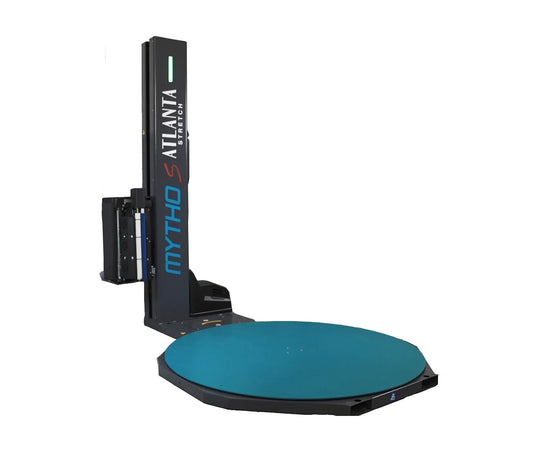
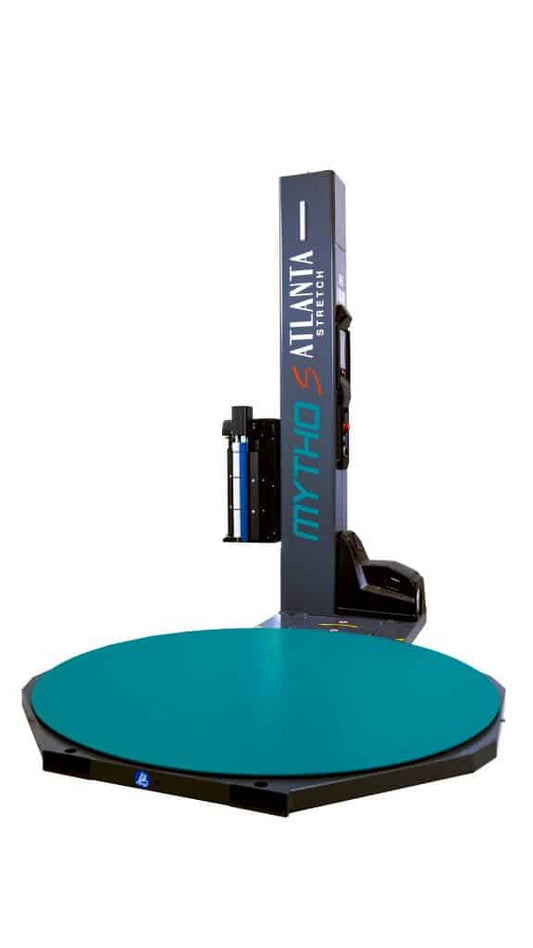
Understanding Film Welding on the Atlanta Stretch Mytho Automatic Pallet Wrapper
When investing in a automatic pallet wrapping system like the Atlanta Stretch Mytho auto, one of the key features that separates high-end automation from basic auto-cut systems is stretch film welding.
Film welding is an advanced film cut-and-seal process that securely fuses the stretch film at the end of the wrapping cycle. Instead of leaving a loose film tail or relying purely on heat wire cutting and mechanical wiping, the machine welds the film to itself, creating a clean, sealed finish on every pallet.
For high-volume operations, this feature significantly improves load security, presentation, and automation reliability.
How Stretch Film Welding Works
On a fully automatic pallet wrapper such as the Atlanta Stretch Mytho, the wrapping cycle typically includes:
-
Automatic film attachment at the start of the cycle
-
Controlled wrapping using a powered pre-stretch carriage
-
Automatic film cutting at the end of the cycle
-
Film welding to secure the film tail
During the final phase, the machine clamps and cuts the film, then uses a controlled heating element to weld the film layers together. This creates a sealed film end that is fused rather than simply tucked or pressed against the pallet.
The result is:
-
No loose film tails
-
No reliance on manual wiping arms
-
No film unraveling during transport
-
A cleaner and more professional pallet finish
Why Film Welding Matters in Automatic Operations
In semi-automatic pallet wrappers, operators often wipe the film tail manually or rely on mechanical cut-and-wipe systems. While effective, these methods can sometimes leave small tails that may lift during transport, particularly in:
-
Cold storage environments
-
High-vibration transport
-
Long-distance freight
-
High-speed production lines
Film welding removes this risk. Because the film is fused to itself, the tail cannot lift or unravel.
For industries running conveyor-fed systems, robotic palletising lines, or high-speed dispatch operations, this consistency is critical.

Improved Load Security and Presentation
Film welding does more than just secure the tail.
It ensures:
-
Consistent end-of-cycle finishing
-
Uniform pallet appearance
-
Reduced film waste
-
Less film contamination on floors
For companies exporting goods or supplying major distribution centres, pallet presentation matters. A welded finish looks cleaner and more professional than a manually wiped tail. Its also highly important for many companies delivering to distribution centers such as coles or woollies where they will reject pallets with tails of films due to the automated lines.
Integration with Powered Pre-Stretch Carriages
On machines like the Atlanta Stretch Mytho, film welding works alongside a powered pre-stretch carriage. This means:
-
Film is stretched efficiently before application
-
Load containment is optimised
-
Film usage is reduced
-
Tension remains consistent
When high pre-stretch performance is combined with film welding, you get both maximum load security and minimal film waste — an important factor when wrapping thousands of pallets per month.

Safety and Labour Benefits
Film welding also supports:
-
Reduced manual handling
-
No operator interaction at end of cycle
-
Safer automated load transfer
-
Consistent results regardless of shift or operator
In fully automated warehouses, every manual touch point removed increases efficiency and reduces risk.
Is Film Welding Right for Your Operation?
Stretch film welding is typically suited for:
-
High-volume manufacturers
-
Distribution centres
-
Automated palletising lines
-
Conveyorised wrapping systems
-
Export operations
-
Businesses seeking fully hands-free wrapping
For lower-volume sites, a semi-automatic wrapper may be sufficient. But once throughput increases, the reliability and consistency of welded film finishing becomes a major advantage.
Final Thoughts
Stretch film welding on a pallet wrapper is the process of automatically cutting and fusing the stretch film at the end of a wrapping cycle to create a secure, sealed finish.
On advanced automatic machines like the Atlanta Stretch Mytho, this feature eliminates loose film tails, improves load security, enhances presentation, and supports true end-of-line automation.
If you're moving toward a fully automated pallet wrapping solution, film welding is one of the key technologies that ensures consistent, professional results — pallet after pallet.
If you'd like to explore whether an automatic pallet wrapper with film welding suits your operation, MPS Packaging Australia can help you assess throughput, layout, film usage, and automation integration requirements.